Sell as bulk
Move it quickly at a price that reflects the work still to do — and accept that anything overlooked leaves with it.
 Unearthed ValueCards organized. Possibilities surfaced.
Trading card inventory processing for game stores
You have a large card inventory you want to keep — but turning it into usable inventory is not worth building an internal operation around.
There are already good ways to liquidate cards, automate recurring high-volume processing, or help staff scan and list faster. If one of those solves your problem better, you should use it.
The processing problem no longer has to live in your store. We take on the backlog project — identification, inventory records, physical locations, exceptions, and the finished searchable inventory system.
Inventory already on your shelves
A healthy card store can still have money tied up in inventory that has already been purchased but is not sufficiently identified, searchable, priced, or retrievable.
The cards may be organized into boxes, sets, binders, collections, or backstock. Physical order alone does not make their exact contents digitally known or practical to retrieve.
When the cost of knowing and retrieving inventory falls, more of that inventory can become economically useful.
Four operational questions
When those answers are too expensive to obtain, part of the inventory is operationally stranded.
The economics of backlog and backstock
Large physical inventories create a commercial processing problem. The harder the cards are to identify and retrieve, the less practical value a store can obtain from them.
So stores make perfectly rational choices.
But every shortcut has a tradeoff. The less time you spend learning what is in the box, the more uncertainty you accept about what you may be giving up.
They sell bulk cheaply. They put boxes out and let customers dig. They pull the obvious valuable cards and leave the rest alone.
They hire people to sort. They invest in equipment and build their own processing workflow. Or they simply let inventory accumulate until there is time to deal with it.
The same boxes of cards
Move it quickly at a price that reflects the work still to do — and accept that anything overlooked leaves with it.
Shift the search work to the customer. Cards can sell, but much of the inventory remains unknown until somebody happens to find it.
Put your own people, equipment, and procedures to work. Gain more knowledge and control in exchange for more labor and investment.
Keep the inventory until there is time to deal with it. Preserve the possibility, but leave the value inaccessible for now.
Every approach trades processing effort against how much of the inventory you can actually know and use.
Bulk is often cheap because
making it useful is expensive.
Low value and unusable
are not the same thing.
That doesn’t mean every common is secretly valuable.
A card buried somewhere among 50,000 others has very little practical value if finding it costs more than the sale.
Change the cost of finding it, and the economics can change too.
A different possibility
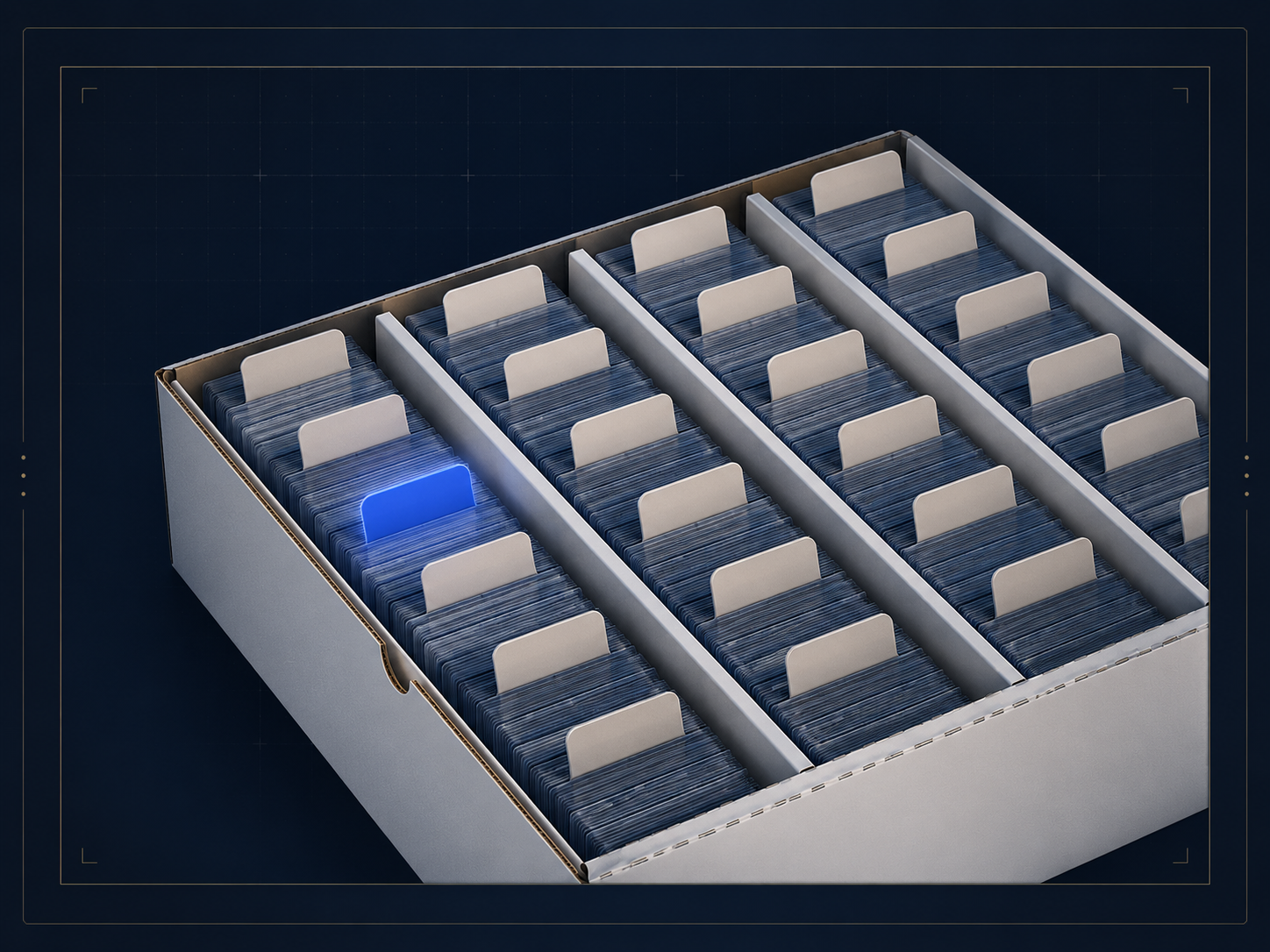
Imagine that the same boxes could stay compact on your shelves — but every card inside them had already been identified.
UNCOMMON · BLOOMBURROW
A useful uncommon that could easily be missed.
SMP-4-7-18Box 4 · Section 7 · Position 18Illustrative example · not customer data
The boxes don’t need to disappear.
The uncertainty does.
The finished inventory layer
Card Catalog is the included day-to-day inventory management application for the singles Unearthed Value processes. It is the software layer your store uses after the physical processing is finished.
Search what you own, see reference pricing, locate processed cards, build pull lists, track availability, refresh pricing, and add future processed batches to the same inventory.
Dashboard
One searchable inventory.
SMP-2-3-42Box 2 · Section 3 · Position 42Sample batches and records · not actual job results
Find cards by name, game, set, value, or other inventory information.
Every processed card carries a physical locator so you can retrieve it without sorting the entire collection into alphabetical order.
If your store does not sell singles below 25 cents, set 25 cents as your minimum store price.
Provider market information remains available underneath it while Card Catalog reflects how your store thinks about the inventory.
Market prices do not stay frozen on the day we process the cards.
Refresh pricing and surface cards that cross a threshold worth pulling.
Search the inventory, select the cards you want, and create an organized retrieval list.
Keep the availability and status of processed cards visible as the inventory changes.
Future batches processed by Unearthed Value can be added to the same inventory.
Card Catalog is included
with the processing service.
Pricing is market/reference information, not an appraisal or a guaranteed sale price. Read the service disclosures.
What Unearthed Value delivers
Before
After
KnownOrganizedRetrievable
From “we probably have one”
to “here it is.”
The service
At your store
Start with a manageable pilot batch or plan a larger inventory when you are ready.
Shipping is included for each separately packed approved ~4,000-card shipping unit. You purchase inbound standard-ground shipping and email us the tracking number and itemized carrier receipt; the eligible inbound transportation charge is credited to your processing job. Unearthed Value pays standard return shipping for each corresponding carton. See shipping details.
With Unearthed Value
We identify the cards, organize the records, associate supported inventory and reference data, and establish physical locations.
Back in your hands
You receive your physical cards along with their identified, valued, searchable inventory and physical locations.
Card Catalog keeps that inventory useful day to day after the job is finished.
Surveyor, not assayer
We identify, document, organize, and report the inventory commissioned by the store. The data belongs to the commissioning customer, and the store remains responsible for its buying and selling decisions.
You don’t need another card-processing system.
You need the result.
Specific solutions for different circumstances
Card stores organize, process, and sell singles in very different ways. Unearthed Value is not built around one universal workflow. Choose the situation that sounds most like your store.
Working capital over time
Prices change. The inventory should not stay frozen in time.
Card Catalog can refresh market-reference pricing, making it possible to see when a card crosses a threshold worth reviewing or pulling without manually repricing an entire backlog.
Reference value is not realized revenue or profit. It is current information that can help a store decide what deserves attention.
Changing values become visible
Known. Locatable.
Worth another look.
Illustrative values · no promised discoveries
Low value doesn’t mean no value
No store should spend several dollars of employee time searching through boxes to make a 25-cent sale.
That is one reason low-end cards collapse toward bulk pricing: the price reflects not only the cards, but the work still required to make them usable.
But if the card is already identified and its location is already known — and the remaining work costs pennies instead of dollars — the equation changes.
Once retrieval is inexpensive, the store gains more ways to use and sell the card. The next question is where that sale makes the most sense.
The question is no longer:
“Is this card worth spending time finding?”
It becomes:
“Do we have it?”
COMMON · THE LORD OF THE RINGS: TALES OF MIDDLE-EARTH
A real common with surprising value.
SMP-2-3-42Box 2 · Section 3 · Position 42Illustrative example · not customer data
Make the inventory easy enough to use, and cards that were impractical to sell can become practical inventory.
Not every card will sell. Not every box contains hidden treasure. Unearthed Value does not promise that it will.
Mapped inventory still has storage and fulfillment costs. This is not an argument for selling every common individually.
Know what you have. Be the store customers turn to when they need something specific.
Known inventory creates options
For stores serving customers in person
Once the inventory is known and searchable, the store gains options it did not have before. For a store that primarily serves customers in person, the first win may simply be knowing what it owns, searching it, finding it, and pulling it confidently.
A Commander player may need the last few cards tonight. A collector may already be standing at the counter. Searchable inventory makes that in-store answer possible whether or not the store sells cards online.
A different conversation
“We might have it.”
“Yes. We have four.”
Illustrative customer interaction
If you already sell online
Marketplaces provide national reach, but each listing sits beside competing copies. Fees reduce the seller’s proceeds, and fulfillment and shipping stand between the buyer and the card.
When the same card is known to be available locally, certainty and immediacy can matter. A player may be willing to pay a little more to take it home now, and the store avoids the marketplace fee.
Sell locally first. Keep the customer.
Not every customer will pay more, and no local premium is guaranteed. The advantage is having another practical channel and retaining the direct store relationship when the local sale makes sense.
Let customers search it too
Store Kiosk is a local, trusted-LAN extension of the same managed inventory in Card Catalog. It makes appropriate available inventory searchable to customers inside your store.
Customers can browse and search Magic and Pokémon cards, see customer-safe card information, add cards to a request, enter their name, and submit the request. Physical locators remain hidden from customers.
Submitting this list does not reserve these cards. Availability is confirmed when store staff begins your pull. Staff sees the named request and internal locators in Card Catalog.
On the store's trusted local network, customers can browse and search available inventory without asking staff to search boxes or binders.
Customers see customer-safe card information, never physical locators, and submit the cards they want under their own name.
Staff sees the named request and internal locators. Inventory is reserved only when staff commits to and begins the pull.
Same store-controlled inventory. Same locations. Unearthed Value does not host the store's live inventory database.
Opportunity cost
Inventory processing can consume hours of valuable employee time. Every hour spent identifying, pricing, sorting, and searching boxes is an hour that cannot be spent helping customers, buying collections, running events, listing high-value cards, shipping orders, or building the player community.
Unearthed Value moves much of that repetitive processing burden out of your labor pool. The goal is simple: lower the cost of making large card inventories usable, and free your staff for the work where human attention creates more value.
A fair question
Absolutely.
Card stores identify, price, sort, catalog, and organize cards every day. We’re not pretending you can’t.
You can dedicate employee time to it. You can hire people specifically to process cards. You can buy equipment. You can select software.
You can build procedures. You can manage exceptions. You can maintain the inventory afterward.
For some stores, bringing all of that in-house makes perfect sense.
Your people.
Your equipment.
Your procedures.
Unearthed Value
processes the inventory
for your store.
Usable inventory
Two valid ways to get there.The question isn’t whether you can do it.
The question is whether you want to build and operate the capability.
Unearthed Value lets you buy the result instead.
We solve the processing problem.
You decide whether avoiding the labor, equipment, workflow development, and ongoing operational headaches is worth the cost.
That’s a business decision only you can make.
They’re your cards
We know — and we don’t expect you to simply take our word for it.
Your cards may contain value neither you nor we know about when they arrive. Handing that inventory to someone else is a legitimate concern, and no policy statement, tracking number, or photograph can make that concern disappear.
Unearthed Value is a small, owner-operated family business. Customer inventory is handled by a very limited number of people, with direct accountability for every job. It is not passed through a large anonymous processing workforce.
Our reputation is essential to this business. Without your trust, Unearthed Value has no business.
That is why we intend to earn it the slow way: careful handling, documented jobs, direct owner accountability, controlled access, small trial batches, references, and customers willing to describe their experience publicly as that record grows.
From receipt through return
Trust is not something we expect you to grant because a website says the right things. If sending inventory off-site is the part that gives you pause, tell us what would make the process feel workable. We are happy to talk through custody, documentation, pilot size, handling, references, or other practical concerns.
We may not have a perfect answer for every store. But if there is a reasonable way to earn your trust, we would rather work through it with you than ask you to ignore the concern.
And trust is earned over time.
You should not have to trust us with your entire back room on day one.
Start small.
See how we handle the work.
See what comes back.
Then decide whether we have earned the next batch.
Owner operated · Goshen, Indiana

I'm Todd Wiley, the owner of Unearthed Value. I'm a longtime Magic player and a quality professional, and I'm the person your cards actually come to when you send them here.
Unearthed Value is a small, specialized operation on purpose. I built it to solve a problem I kept seeing in card stores: good inventory that exists, but is difficult to use because the labor required to identify, organize, and make it searchable never reaches the top of the priority list.
If you are happy selling bulk immediately and never want to revisit it, you may not need us.
If your existing staff and equipment already process everything you acquire efficiently, you may not need us.
That’s okay.
The stronger fit is a card shop or serious dealer with substantial volume, a processing backlog, limited staff time, or purchased inventory waiting for attention.
Unearthed Value is for stores that look at boxes of cards and think:
“There is probably value in there.”
“Customers probably want some of those cards.”
“We simply don’t have a good reason to spend our time finding out.”
That’s the problem we want to solve.
You don’t have to start with everything.
Start with a batch. See what is there. See what the finished inventory looks like.
Then decide whether Unearthed Value makes sense for the rest.
Email Todd at todd@unearthedvalue.com
Unearthed ValueCards organized. Possibilities surfaced.